You found a brown recluse in the house. What that actually means
One spider is information. Several over a fortnight is a pattern, and patterns are treatable.
September 17, 2026 · 4 min read
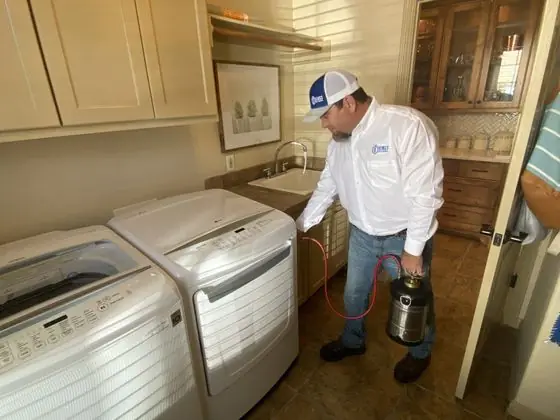
A Georgetown customer once described seeing multiple brown recluse spiders in her house and being, in her own words, freaked out by it. She called King's, the office worked around her schedule to get a technician out the next morning, the treatment was thorough, and months later she had not seen another one. That sequence is worth walking through, because the panic part is the least useful part and the rest is quite practical.
Why they are in the house at all
Recluse spiders are not aggressive and they are not interested in people. The name is accurate. They want somewhere undisturbed, dry and dark, with something to eat. Houses supply all three reliably, and they supply them in places nobody looks at for months at a time.
That is also why a sighting says very little about how clean a house is. An immaculate home with a stack of stored boxes in a closet is excellent habitat. The thing that matters is undisturbed, not dirty.
Where they hide
- Stored boxes, particularly cardboard that has sat for a season or more
- Closets, wardrobes and anything at the back of a rarely opened cupboard
- Garages, attics and crawl spaces
- Behind and underneath furniture that does not get moved
- Clothing, shoes and bedding that have been out of rotation
Most bites happen through contact rather than approach, which is to say a spider is in a sleeve or a shoe or under a hand reaching into a box. Shaking out clothing and shoes after any sighting is a small habit that removes most of the realistic risk.
One spider or a population
A single sighting is genuinely common and does not necessarily indicate much. Repeated sightings over a couple of weeks, sightings in more than one room, or sightings in a bedroom, are a different signal. That pattern usually means there is a harbourage somewhere in the building that is producing them.
Finding that harbourage is most of the work, and it is also the part that is difficult to do yourself, because the places worth checking are the places that are unpleasant to check.
Season matters as well. Sightings tend to rise when conditions outside change sharply, because spiders that were content in a garage or a wall void start moving through the building looking for somewhere more stable. A run of sightings after the first real cold snap, or during the worst of the summer heat, is a fairly ordinary pattern rather than a sign that something has suddenly gone wrong with the house.
It is also worth being honest about identification. Several harmless spiders in central Texas get called brown recluse, and the markings people rely on from the internet are easy to misread on a specimen that is moving quickly across a floor. That does not mean you should ignore it. It means the useful question is whether the property has a population, not whether one particular spider was correctly named.
What a thorough treatment looks like
A technician treating for spiders works the quiet zones rather than the visible ones. Storage areas, closet corners, the backs of cupboards, garages, the attic access, and the voids where spiders move between rooms. The perimeter of the building gets treated too, because the insect population outside feeds what lives inside.
That last point is the one people skip. Spiders are predators. Reduce the crickets, small roaches and flying insects a property supports and you have reduced the reason for spiders to stay. A general pest control visit does that as a matter of course, which is why spider problems often improve on a regular service even when nobody specifically asked about spiders.
What you can do this weekend
- Swap long term cardboard storage for sealed plastic bins where you can
- Pull stored boxes away from walls so there is no permanent dark gap
- Shake out shoes, gloves and stored clothing before putting them on
- Vacuum closet corners, skirting lines and behind furniture that rarely moves
- Fit or repair door sweeps, since a gap under a garage door is an open invitation
When to call King's
Call if you have had more than one sighting, if any of them were in a sleeping area, or if you simply do not want to be the person checking the attic. Tell the office which rooms and roughly how often. The Georgetown office is at 603 River Bend Dr, open Monday to Friday, and with nine trucks on the road an urgent visit can usually be arranged quickly.
There is no long term contract, and if the technician thinks what you found is not a recluse at all, they will tell you that too.
King's Pest Control, (512) 930-7378
Call (512) 930-7378More articles
Why scorpions turn up indoors in Georgetown, and what keeps them out
They are not coming in for food. They are coming in because the outside stopped suiting them, and your house did.
Why fire ant mounds keep coming back in a Williamson County yard
If new mounds appear two weeks after you treated the old ones, the colony did not die. It moved.